
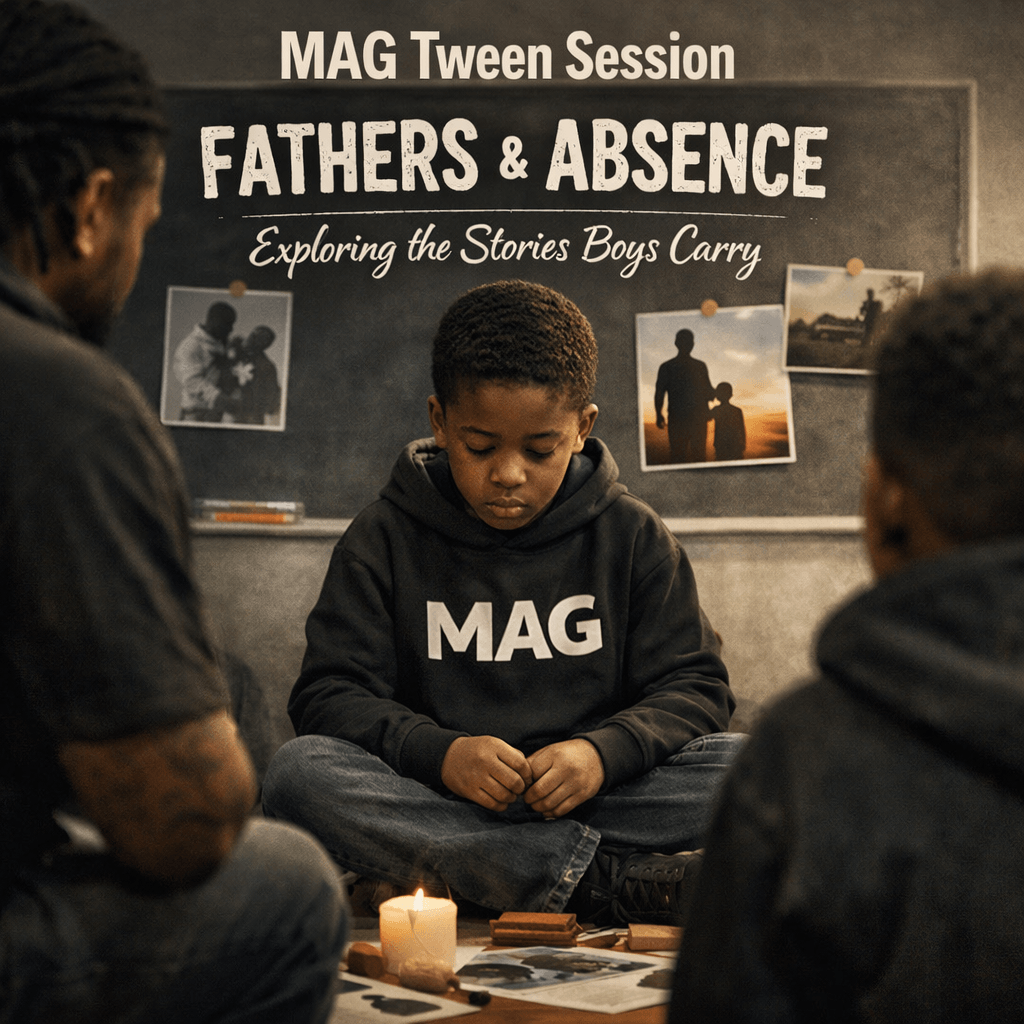
Session Title – Fathers, Absence and the Stories Boys Carry
Date: The day before Mother’s Day (March 2026)
Location: MAG HQ
Session Led By: MAG Facilitators
Participants: 9 young masters (Ages 9–11)
Duration: 3 Hours
At MAG, we do not rush development.
We understand that boys do not become men by accident — they are shaped, guided, challenged and held.
Our work is rooted in a simple but powerful understanding:
Behaviour is communication.
And beneath every behaviour is a story waiting to be understood.
We create spaces where young masters are not judged by what they show on the surface, but supported to explore what sits underneath — their emotions, their identity, their relationships and the silent influences shaping their decisions.
This session was a reflection of that approach.
It was not a lecture.
It was not a lesson to complete.
It was a carefully held experience — one that engaged the body, the mind and the emotions, allowing truth to surface in a way that felt safe, human and real.
Session Context
Working with boys aged 9, 10 and 11 places us at a critical point in their development.
This is the stage where beliefs begin to form with weight.
Where experiences start to settle into identity.
Where silence, if left unchallenged, begins to shape behaviour.
This session, taking place the day before Mother’s Day, provided a natural entry point into exploring family, connection and the emotional landscape of fatherhood — a topic often felt deeply but rarely spoken about openly at this age.
We began with movement.
Press-ups.
Energy.
Activation.
Not simply as physical exercise, but as a way of grounding the boys in their bodies, building discipline and signalling that this space requires presence.
From there, we transitioned into soul gazing — an exercise where the young masters sat opposite one another and maintained eye contact without speaking.
Initially, the room responded as expected — laughter, discomfort, avoidance.
But as the exercise continued, something shifted.
The boys began to settle.
To hold eye contact.
To experience what it means to truly see and be seen.
This practice develops emotional awareness, empathy and presence — qualities that are often underdeveloped in boys, yet essential for healthy relationships and identity formation.
Regulating the Mind
Following this, we guided the group into a short meditation.
Breathing slowed.
Bodies softened.
The room quietened.
For many young boys, stillness is unfamiliar territory.
However, it is within stillness that emotions begin to surface and self-awareness begins to grow.
Before a boy can express how he feels,
he must first learn how to sit with what he feels.
Building Brotherhood
The session was not solely focused on depth — it also made space for connection through joy.
There were jokes.
Moments of laughter.
Shared humour that reminded us these are still children navigating complex emotions.
We also shared food together — patties — which, while simple, played an important role in building community.
Eating together creates belonging.
It removes barriers.
It reinforces the idea that this is not just a programme — it is a brotherhood space.
The Conversation – Mothers and the Shift
Given the timing, we began by exploring Mother’s Day.
The young masters spoke openly about their mums — their care, their presence, their sacrifices.
The reflections were rich and heartfelt.
Stories were shared that reflected love, gratitude and admiration.
There was pride in their voices and a natural ease in the conversation.
However, within that warmth sat something else.
An absence that had not yet been named.
The Deep Dive – Fathers
As the conversation transitioned towards fathers, the atmosphere changed noticeably.
The room became quieter.
Energy lowered.
The boys became more guarded.
When asked about their fathers, many responded quickly:
“I don’t have a relationship with my dad.”
At face value, this appeared to be a clear statement.
At face value, this appeared to be a clear statement.
But as the space held — supported by the earlier exercises that had already built connection and safety — a deeper truth began to emerge.
These boys are not without relationship.
They are in relationship with absence, inconsistency, confusion and, in some cases, emotional pain.
What Emerged
The vulnerability that followed was careful but powerful.
Some of the reflections included:
“He’s there… but I don’t really know him.”
“I don’t talk to him like that.”
“It feels like he’s not really there for me.”
And quietly:
“I don’t talk to him like that.”
“It feels like he’s not really there for me.”
And quietly:
“It makes me feel empty sometimes.”
These statements reveal more than circumstance — they reveal interpretation.
These statements reveal more than circumstance — they reveal interpretation.
These young masters are already forming internal narratives about what their fathers’ presence or absence means about them.
As explored in the Father Hunger material, it is often not just the absence itself that shapes a boy, but the meaning he creates from it — meaning that can influence identity, behaviour and emotional development over time.
The Pattern Beneath the Surface
What we witnessed was not simply absence.
It was active emotional influence.
Because when a boy experiences inconsistency, distance or lack of connection, he adapts.
And those adaptations, if left unaddressed, begin to shape the types of men he may become:
The emotionally closed man, who learned early that vulnerability had no safe place
The angry man, who expresses pain through frustration rather than words
The approval-seeking man, still searching for validation that was never grounded
The disconnected man, who struggles to form secure relationships
The hyper-independent man, who believes he must rely only on himself
At 9, 10 and 11 years old, these are not fixed outcomes — but the early blueprint is visible.
Professional Reflection
This session highlighted something that cannot be ignored.
These young masters — still in primary years — already hold structured and, in some cases, hardened views about their fathers.
If, at this age, they are struggling to articulate what they feel,
then we must consider what those feelings will become by adolescence, when external influences intensify and identity becomes more rigid.
As the Father Hunger material outlines, unmet emotional needs do not fade with time; they often deepen, embedding themselves into behaviour, relationships and self-perception.
When we later encounter challenging behaviour, emotional withdrawal or risk-taking, we must understand that these are often not isolated incidents, but expressions of unresolved emotional experiences.
This session does not end with the boys.
It extends to the adults reading this.
What is your relationship with your father?
Not the surface answer.
The honest one.
Because our ability to hold space for young people is directly linked to our willingness to explore our own stories.
At MAG, we hold a principle that guides our work:
Heal the boy, and the man will appear.
But healing is not passive.
It requires intentional spaces, consistent presence and adults who are willing to engage with discomfort rather than avoid it.
This session — through movement, eye contact, stillness, shared food, humour and honest conversation — was designed to create that environment.
It signalled to these young masters:
You are seen.
You are heard.
And your story matters.
Importance of the Space
Within three hours, the young masters were able to:
Build connection through physical activity and shared experience
Develop empathy and presence through soul gazing
Regulate emotions through meditation
Experience belonging through shared laughter and food
Explore complex emotional realities around fatherhood
This is not simply a session.
This is preventative, relational work at its most foundational level.
Do not wait until behaviour escalates.
Do not wait until silence becomes something louder.
Start now.
Create space.
Ask questions.
Listen without judgement.
For further insight into this area, explore the Father Hunger resource via Aisle 23:
Because ignoring the emotional experience does not remove it —
it only delays how and when it shows up.